The BENCH cluster focuses on gold-standard laboratory equipment that is not portable, can run at high capacity, and can produce results at the highest levels of sensitivity and resolution.

BENCH
AVAILABLE INSTRUMENTATION
Phoenix V|tome|x M300
This micro- computed tomography (micro-CT) system, manufactured by Waygate Technologies (a Baker Hughes Company) features two X-rays tubes: a 300 kV / 500 W microfocus option and a 240 kV / 320 W nanofocus option, allowing for resolutions of <2 μm (microfocus) or <0.5 μm (nanofocus). The system can sustain objects of up to 50 kg in weight and up to 50 x 60 cm in size.
Further details and specifications can be found on the Baker Hughes Website.

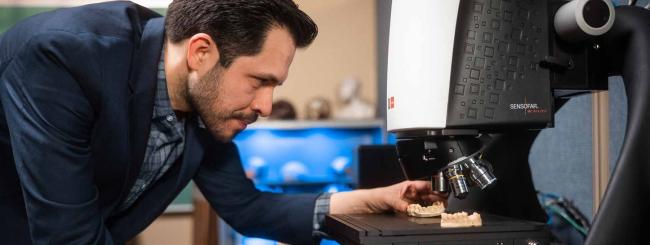
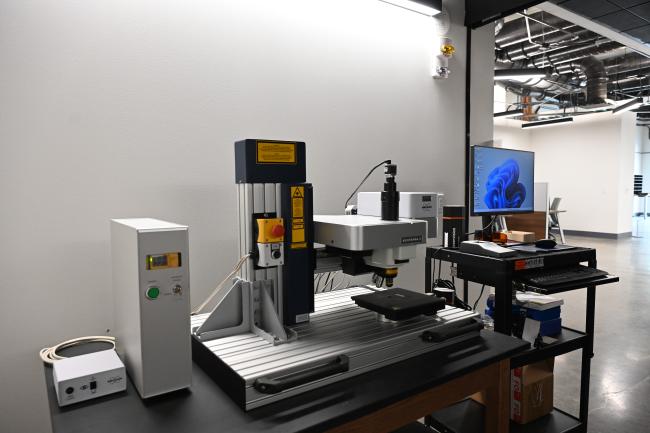
Sensofar S Neox Confocal Microscope
The Sensofar S Neox is a confocal microscopy system that uses a 4-in-1 technology: Ai focus variation, which gathers image sets of the sample at multiple planes to generate a composite continuous image of the surface; Confocal, which allows only in-focus light to enter the imaging system; Interferometry, which enables the user to generate a spatial inteference pattern to view surface topology of the sample; and Thin-film, measures the thickness of optically transparent layers non-destructively. In addition, the S Neox utilizes LED lights instead of a standard laser, allowing for faster measurement and the use of different wavelengths for different samples. More details and specfications on the Sensofar S Neox Confocal Microscope can be found on the Sensofar Website.
Thermo Fisher Quattro ESEM
The Thermo Fisher Quattro Environmental Scanning Electron Microscope (SEM) is a field-emission environmental scanning electron microscope designed for high-resolution imaging and elemental analysis of a wide range of materials. Its environmental mode supports analysis of uncoated, hydrated, insulating, or otherwise sensitive samples that may be difficult to examine under conventional high-vacuum SEM conditions. The system is equipped with dual Bruker XFLASH EDS detectors for efficient elemental analysis and large-area chemical mapping, allowing fine-scale morphology with spatially resolved compositional information.
Further details and specifications can be found on the Thermo Fisher Website.

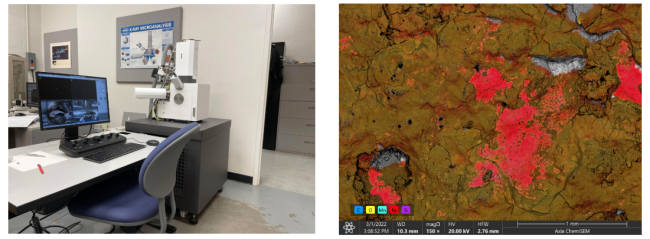
Thermo Fisher Axia ChemiSEM
The Thermo Fisher Axia is a Scanning Electron Microscope (SEM) that also collects Energy Dispersive Spectroscopy (EDS) data in real time, allowing for a chemical characterization and elemental analysis of a sample. This makes the Thermo Fisher Axia SEM able to display both morphology and quantitative elemental make up together in real time, as a visualized color-coded elemental display of sample. This system is ideal for research concerned with elemental analysis on microscopic surfaces.
Further details and specifications can be found on the Thermo Fisher Website.
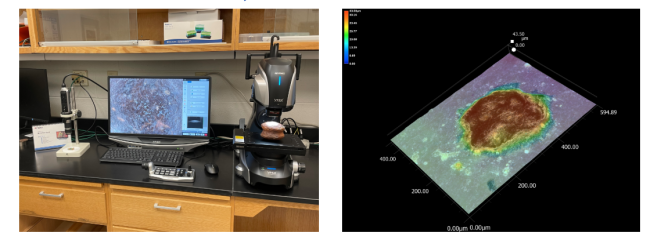
Keyence VHX-7000 Scanning Optical Microscope
The Keyence VHX-7000 scanning optical microscope is a digital microscopy system that allows for bright field, dark field, and Differential Interference Contrast (DIC) modes. The system features automatic alignment, focus, adjustment, and magnification switching as well as 90 degrees of tilt, relieving the difficulties of manual alignment seen in other microscopy systems. The VHX-7000 also features an Optical Shadow effect mode which vastly increases elevational contrasts in a given sample, making this microscope system ideal for research involving analysis of surface features and morphologies.
Further details and information can be found on the Keyence Website.
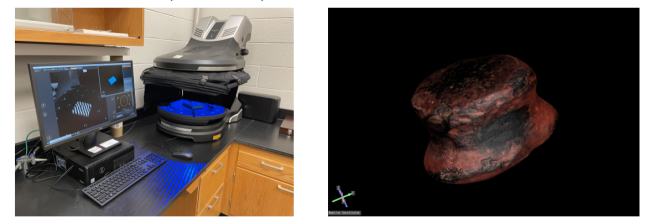
Keyence VL-500 Blue Light Object Scanner
The VL-500 Blue Light Object Scanner is a 3D-Scanning systems that uses higher wavelength blue light to generate 360-degree 3D models of objects. The scanner automatically recognizes object size and dimensions with a repeatability error rate of up to 2 µm 0.000079” and can acquire up to 16 million points per scan. This makes this scanning system ideal for research concerned with precise surface feature measurement.
Further details and information on this system can be found Keyence Website.
Atlas X micro-XRF Spectrometer
The Atlas µXRF system provide a tiny focal spot (down to 5 μm, depending on desired configuration) that allows for enhanced trace element analysis and the creation of hyperspectral images of a sample. It features the industry’s most voluminous sample chamber (940 x 660 x 355 mm), allowing for automation of more samples, larger area mapping capabilities, and wider variability of sample types.
Further details and information on this system can be found IXRF Website.

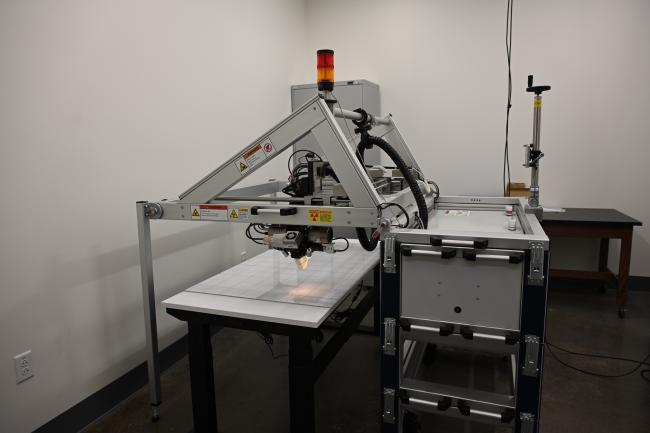
Bruker M6 Jetstream micro-XRF Scanner
The Bruker M6 Jetstream is a large-area micro-XRF scanner designed for non-destructive elemental analysis and spatially resolved chemical mapping of large objects and surfaces. The system features a spot size down to 100μm, open-face architecture, and large-area mapping capabilities up to 80 x 60 cm, allowing for analysis of samples that may be difficult to place inside a traditional enclosed chamber. Its curved-surface capability makes the system especially useful for research involving cultural heritage objects, artifacts, geological samples, and other complex surfaces where elemental composition needs to be mapped across broad or uneven areas.
Further details and specifications can be found on the Bruker Website.
Bruker TRACER 5 Handheld pXRF Spectrometer
The Bruker TRACER 5 is a portable X-ray fluorescence spectrometer designed for non-destructive elemental analysis in laboratory, field, and museum settings. The system can measure up to 48 elements and features a silicon drift detector (SDD) with energy resolution of less than 140 eV, allowing for precise chemical characterization of a wide range of materials. The TRACER 5 supports selectable 3 mm or 8 mm measurement spots and can operate in air, vacuum, or helium atmospheres, making it adaptable for different sample types and analytical needs. Its handheld design makes it especially useful for artifact analysis, conservation research, archaeological materials, geological samples, and other studies requiring elemental analysis outside of the lab.
Further details and specifications can be found on the Bruker Website.

|

|
Bruker LUMOS II FTIR Microscope
The Bruker LUMOS II is a stand-alone FTIR microscope designed for spatially resolved chemical analysis and imaging of materials, surfaces, and micro-samples up to 40 mm in height. The system supports transmission, reflectance, and attenuated total reflectance (ATR) measurement modes, allowing the analysis of samples using the method best suited to their material type and preparation needs. Its chemical mapping capabilities make it possible to visualize molecular and compositional differences across surfaces, producing spatially resolved FTIR data that can support studies of cultural heritage materials, polymers, coatings, biological samples, and other heterogeneous materials.
Further details and specifications can be found on the Bruker Website.

Bruker ALPHA II FTIR Spectrometer
The Bruker ALPHA II is a compact FTIR spectrometer designed for reliable molecular and chemical analysis of materials in laboratory, museum, and field settings. The system uses a rigid metal body, temperature-controlled detector, and permanently aligned cube-corner interferometer to support stable measurements across a spectral range of 350–8,000 cm⁻¹ with standard optics, or 500–6,000 cm⁻¹ with a high-humidity configuration. Detachable ATR and diffuse reflectance sampling heads allow the system to be adapted for different materials and surface conditions, while its portable design and tripod mount support in situ analysis of cultural heritage objects, conservation samples, coatings, minerals, and other research materials.
Further details and specifications can be found on the Bruker Website.

Bruker SENTERRA II Raman Microscope
The Bruker SENTERRA II is a confocal Raman microscope designed for molecular and chemical characterization of materials, surfaces, and micro-samples. The system includes 785 nm and 532 nm laser excitation options and supports confocal Raman mapping for high-resolution chemical imaging across surfaces. Its open microscope architecture allows analysis of larger samples that may not fit easily within enclosed instruments, making it useful for cultural heritage objects, geological materials, conservation samples, pigments, coatings, and other heterogeneous surfaces. The SENTERRA II’s confocal mapping capability, with spatial resolution below 100 nm, enables detailed visualization of molecular composition and material differences at very fine scales.
Further details and specifications can be found on the Bruker Website.
Bruker BRAVO Handheld Raman Spectrometer
The Bruker BRAVO is a battery-powered handheld Raman spectrometer designed for non-destructive molecular identification in laboratory, field, and museum settings. The system covers a spectral range of 300–3,200 cm⁻¹ with a spectral resolution of 10–12 cm⁻¹, supporting rapid material identification across a broad range of samples. Its 785 nm and 852 nm sequential laser excitation system helps suppress fluorescence, making it useful for materials that are difficult to analyze with conventional Raman systems. The BRAVO’s portable, handheld design supports in situ analysis of artifacts, pigments, minerals, conservation materials, and other objects that cannot be easily moved or sampled.
Further details and specifications can be found on the Bruker Website.
